
A cold lead is not always a lost cause. For most insurance agencies, the real issue is not having too few leads. The problem starts after the first contact fails. Prospects stop replying. Follow-ups stack up. Soon, a database that once held promise becomes a list no one touches.
This is where insurance lead reactivation has become one of the most strategically important capabilities an agency can develop. And artificial intelligence is changing how that reactivation works, not just in speed, but in relevance.
The traditional approach treats all unresponsive leads the same. A generic drip email goes out. A voicemail gets left. Nothing happens. But AI does not operate that way. It learns from behavioral signals, lead source patterns, and engagement history to build a distinct outreach strategy for each lead segment. The result is that aged insurance leads that most agencies have written off can, with the right AI-powered system, be turned into active conversations and eventually closed policies.
In this post, I will explain how this process works, how AI can re-engage best, and what agencies should know before getting started.
Why One-Size Follow-Up Fails (And What AI Does Instead)
Consider a mid-sized independent agency with a database of several thousand unworked leads. Some of those leads requested auto quotes two years ago. Others inquired about life insurance but never scheduled a call. A handful are referrals who gave a name and number and then disappeared.
A standard drip campaign will send the same three-email sequence to all of them. AI-driven insurance lead follow-up does the opposite. It segments the database by lead type, analyzes what stage of the buying process each lead was likely in when they went silent, and then builds separate outreach logic for each group.
The main difference is that AI can personalize at scale. It looks at details such as company size, prior interactions, and the lead's initial contact with the company. Then it chooses the right message, tone, and timing. This goes beyond simple mail-merge. The follow-up changes based on how each person reacts.
Research shows that message relevance is the primary driver of response rates. When outreach reflects what a lead actually cares about rather than a generic insurance pitch, the probability of re-engagement rises significantly.
The Four Lead Types AI Is Built to Re-Engage
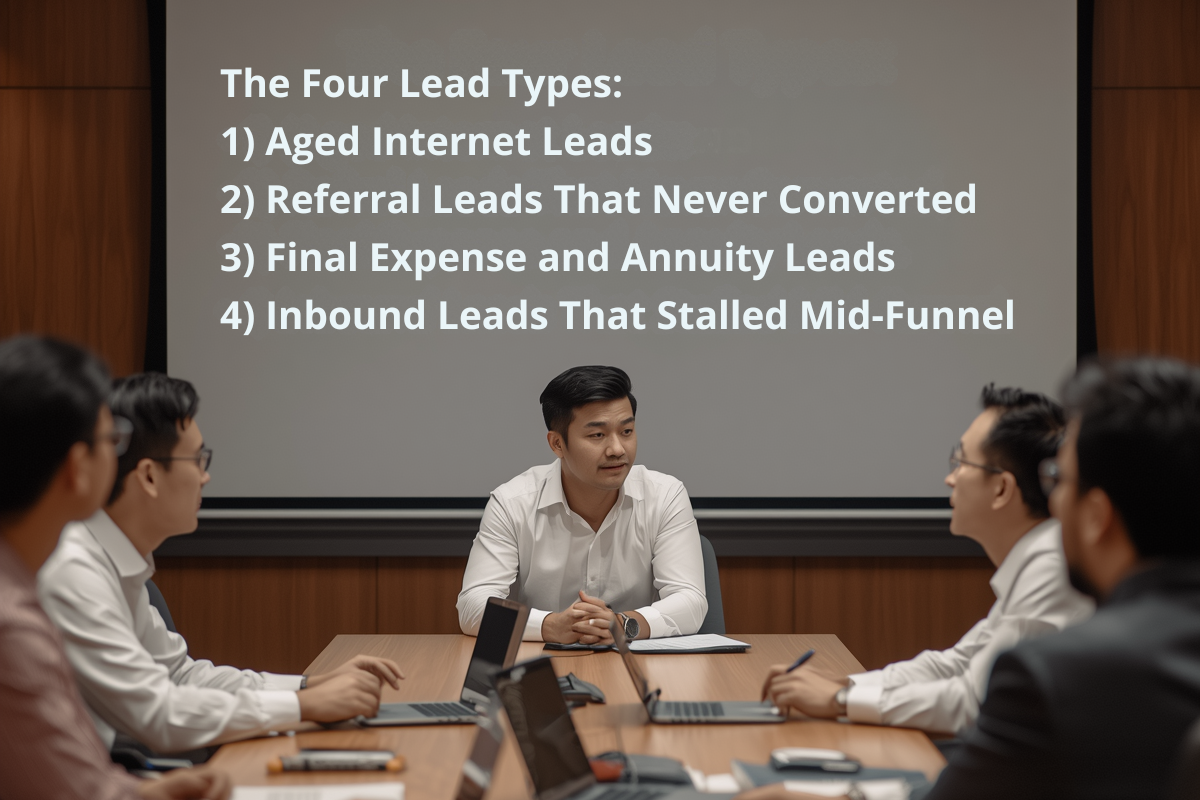
1. Aged Internet Leads
These are the leads most agencies assume are dead. They came in through a comparison site, received a flood of calls in the first 72 hours, and then went completely silent. The typical agency writes them off after 30 days.
AI approaches aged insurance leads differently, acknowledging that these leads are often not uninterested. They are overwhelmed. When AI outreach arrives weeks or months later with a low-pressure, conversational tone through SMS or email, it creates a different experience than the first onslaught of calls. Studies on SMS-based lead reactivation show that approximately 5.2% of cold leads will respond when re-engaged through text.
What AI does well here is pacing. It does not spam. It recognizes when a lead has been contacted too recently and holds outreach until an appropriate interval has passed, preventing the lead fatigue that kills response rates.
2. Referral Leads That Never Converted
Referrals arrive warm but can go cold quickly. If the timing was off, if a prospect was mid-renewal with another carrier, or if the agent simply did not follow up fast enough, that referral can sit unworked for months.
AI systems trained on referral lead behavior know that this segment typically requires a different entry point in re-engagement. Rather than starting from scratch with an educational email, the AI can reference the first referral context, which is a strong signal of trust, and use it to restart the conversation in a personal rather than promotional style.
3. Final Expense and Annuity Leads
These leads often have longer sales cycles and higher emotional risks. A prospect who expressed interest in a final expense policy six months ago may have been dealing with a family situation, a financial concern, or simply needed more time to process the decision.
AI trained on this lead type learns to approach re-engagement with patience and sensitivity. The messaging cadence is slower, and the tone is consultative. The goal is not to push toward a decision but to re-establish contact and let the human agent step in once the lead signals readiness.
This is where the handoff protocol matters most. AI handles initial qualification and research, but for these lead types, a licensed agent must take over for consultative selling. There is also a compliance consideration for agencies: AI can process information and generate quotes, but it cannot legally bind an insurance policy. A licensed agent is always legally required for that step.
4. Inbound Leads That Stalled Mid-Funnel
Some leads show clear interest by visiting your website, filling out a form, or using a quote tool, but then stop replying before they finish the process. These are great candidates for AI follow-up because there is already useful data to work with.
AI reviews what a lead looked at before they went quiet and uses that to write follow-up messages that address exactly where they stopped. For example, if someone compares term and whole life insurance but does not request a quote, the AI will start the conversation there instead of sending a generic intro.

How AI Learns: Behavioral Signals and Adaptive Logic
The phrase 'AI learns' can sound abstract, so it is worth being specific about what that actually means in the context of lead reactivation.
When an AI insurance lead follow-up system is deployed against a lead database, it begins by classifying leads based on available data: source, age, prior contact attempts, response history, and any demographic or behavioral signals attached to the record. From that baseline, the AI builds outreach sequences customized to each segment.
As the system works, it tracks what gets results. It checks which subject lines get opened, which messages get replies, and what times of day work best. This feedback helps the AI improve its follow-up, so it is always adjusting to what works for each group.
This is the mechanism behind AI-personalized campaigns achieving open rates of 40 to 50 percent, compared to the industry standard of 20 to 30 percent. The performance gap stems from relevance, and relevance stems from the AI's ability to learn what connects with a specific lead type rather than broadcasting a one-size-fits-all message.
Good AI systems also watch for signs that a lead is getting tired of follow-ups. If someone has been contacted several times without replying, the AI will pause and wait for a better time to call again. This protects your brand and keeps the lead open for future contact.
What Agencies Get Wrong When Trying to Scale Follow-Up
Most agencies that struggle with how to get insurance leads to respond are making one of a few consistent mistakes.
- They treat all unresponsive leads equally, ignoring significant differences in lead type, original intent, and time since last contact.
- They rely on volume over relevance, sending more messages rather than smarter ones.
- They fail to build a structured handoff protocol, so when AI does reactivate a lead, the human follow-up is not ready to capitalize on the momentum.
- They measure the wrong metrics, focusing on contact volume rather than qualified conversations and conversion rates.
Successful AI adoption in insurance agencies follows the 10/20/70 rule, also known as the 10/20/70 rule. Ten percent of the effort goes to the algorithms themselves, 20 percent to the technology and data infrastructure, and 70 percent to the human dimension: training, process redesign, and cultural adoption. Agencies that skip the 70 percent often find that their AI tools underperform not because the technology is flawed, but because the people and processes around it were not redesigned to leverage it.
The practical implication is that deploying AI for insurance lead revival requires more than plugging in a new tool. It requires rethinking how leads are categorized, how handoffs are structured, and how agents are trained to receive AI-qualified prospects and close them.
How Lead Revival Bridges the Implementation Gap
Building an AI-driven lead reactivation system from scratch requires considerable technical infrastructure: CRM integration, machine learning model configuration, compliance guardrails, and ongoing quality assurance. Most independent agencies and smaller IMO/FMO operations do not have the internal resources to build this themselves.
Lead Revival was created to solve this problem. Instead of having agencies build and manage their own AI, Lead Revival offers a managed service that handles the technical side and delivers what matters: qualified leads ready for your agents to close.

Specialized Reactivation of Dormant Databases
Lead Revival's systems are specifically trained to reactivate specific types of insurance leads using AI. The platform is pre-configured to recognize the behavioral and contextual signals that distinguish an aged internet lead from a stalled referral or a mid-funnel drop-off. That specificity is what makes the outreach feel relevant rather than robotic.
Agencies with months or years of untouched leads often find that many of those contacts are still good prospects. Lead Revival's system searches through old data and uses AI to score which leads are most likely to respond.
Built-In Human-in-the-Loop Oversight
One of the most important safeguards in any AI-powered outreach system is oversight. AI output that is not reviewed can produce off-brand responses, compliance issues, or messaging that misrepresents the agency. Lead Revival manages this quality assurance step directly.
Only warm, verified, and qualified leads go to your agents. This way, agents focus on real conversations instead of cold outreach. The oversight step also makes sure every AI message meets your agency's standards.
Removing the Technical Barrier for Independent Agencies
Enterprise AI tools are easier to get now, but setting them up and keeping them running can be too much for smaller agencies. Lead Revival solves this by handling the technical work for you. This lets independent agents use the same high-quality AI reactivation as big carriers.
Measuring What Matters: ROI for AI-Driven Lead Reactivation
Any investment in AI tooling should be evaluated against clear performance benchmarks. For scale insurance agent follow-up through AI, the metrics that matter most are not open rates or click rates. They are qualified conversations and conversion outcomes.
Agencies piloting AI reactivation programs typically report recovering 10 to 15 hours per agent per week by reallocating time previously spent on manual follow-up tasks. That time recapture alone represents significant value before accounting for the incremental revenue generated by leads that would otherwise have remained dormant.
A good goal for AI investment is at least 200% ROI within 3 to 6 months. This includes time saved, extra revenue from revived leads, and lower costs for finding new leads.
If your agency is new to AI, start small. Begin with simple steps like lead routing, automatic reminders, and texting old leads. These easy wins show results fast and help your team get comfortable before moving to more advanced uses.
Conclusion: Your Best Leads May Already Be in Your CRM
The most common mistake agencies make with their lead inventory is treating silence as a closed door. Insurance lead reactivation powered by AI changes that equation because the system does not just send more messages. It sends smarter ones to the right lead type, at the right time, with the right context.
Understanding how to work old insurance leads is no longer about increasing contact attempts. It is about understanding what each lead type needs to re-engage and deploying AI tools that are trained to deliver exactly that.
If you want to turn your old database into an active pipeline without building your own tech, start by reviewing your CRM. Then look for a managed AI solution to do the hard work for you.
If your agency is sitting on unworked leads, the opportunity to convert them remains. The question is whether you have the right system in place to act on it.

References
- (2026). Do I Need an Insurance Agent: Required vs. Optional - LegalClarity. LegalClarity. https://legalclarity.org/do-i-need-an-insurance-agent-required-vs-optional/
- (2026). FAQs | My Lead Revival – Lead Reactivation Made Simple. My Lead Revival. https://www.myleadrevival.com/faq
- (September 28, 2025). Financialize Launches Lead Revival. Financialize. https://www.financialize.com/blog/financialize-launches-lead-revival-combining-ai-and-human-verification-to-turn-dormant-insurance-leads-into-guaranteed-appointments
- McMillan, M. (n.d.). The Forgotten Goldmine: How to Reactivate Dormant Leads Through Omnichannel Strategy. https://www.myleadrevival.com/post/the-forgotten-goldmine-how-to-reactivate-dormant-leads-through-omnichannel-strategy
- Rodriguez, M. (n.d.). ROI of AI: Real Numbers from Real Companies. https://www.ademero.com/blog/roi-of-ai-real-numbers